"Tell me about a time when…"
Five words that make a lot of us freeze. You know you've done good work. But in the moment, your answer wanders, you lose the ending, and you leave the room thinking of everything you should have said.
The STAR method fixes that. It turns your experience into a short, clear story an interviewer can follow. And like any skill, it gets easier every time you practise it.
STAR in 30 seconds
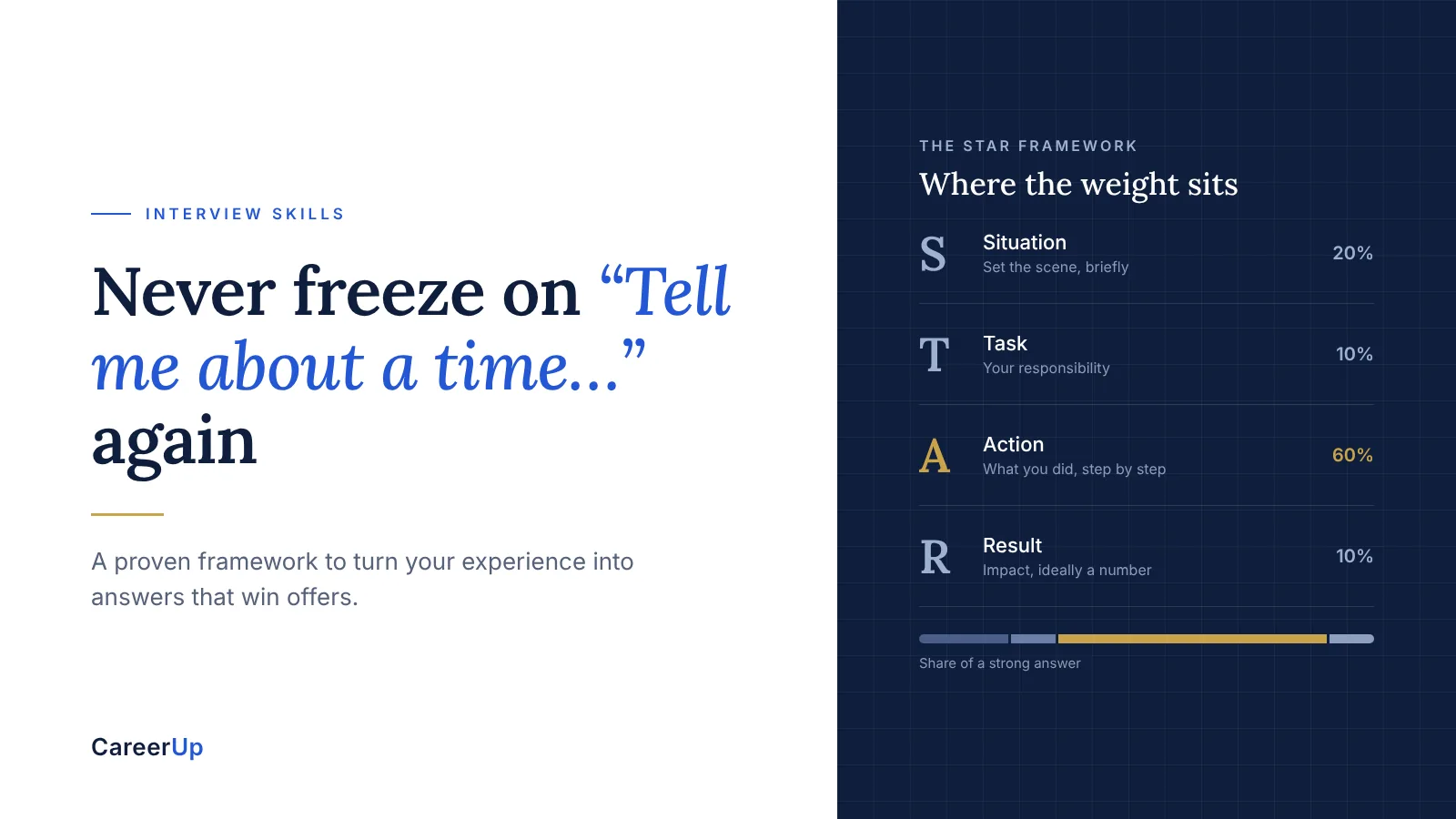
| Letter | Stands for | Ask yourself | Share of your answer |
|---|---|---|---|
| S | Situation | Where were you, and what was going on? | about 20% |
| T | Task | What was your job in this? | about 10% |
| A | Action | What did you actually do, step by step? | about 60% |
| R | Result | What changed, and what did you learn? | about 10% |
The percentages are a rule of thumb from the careers teams at MIT and the University of Washington, not a stopwatch. The point is where the weight sits: Action. That's the part the interviewer is really listening for.
STAR in action: two examples
First, an answer without STAR: "I'm good with people. I stay calm and it usually works out." Fine, but forgettable. Now compare the two below: one for graduates, one for mid-career professionals.
Retail example (graduate)
The question: "Tell me about a time you dealt with a difficult customer."
S: "In my retail job during university, a customer came in upset. Her online order had arrived damaged, two days before her son's birthday."
T: "I was on the till on my own, and it was down to me to fix it without losing the sale."
A: "I apologised first and didn't argue. Then I checked stock, found the same item at our other branch and arranged a same-day transfer. I gave her my name so she could ask for me when she came back."
R: "She collected it that evening and later left a review mentioning me by name. It taught me that owning a problem calms people down faster than explaining it."
Office example (mid-career)
The question: "Tell me about a time you won over a difficult stakeholder."
S: "I was leading the roll-out of a new expenses system across three offices. Two months in, the finance manager at our biggest site still refused to switch over."
T: "As project lead, I had to get her team on board before the old system was switched off at the end of the quarter."
A: "I booked an hour with her to listen rather than pitch. Her real worry was that month-end reporting would break. So I set up a two-week trial running both systems side by side, and had our analyst rebuild the report she relied on."
R: "Her team moved over a week early, and she ended up walking the other sites through the new process. I learned that resistance usually has a specific reason, and it pays to find it first."
Different jobs, different stakes, same four steps. Use the one closest to where you are now: a part-time job, a placement or volunteering works just as well as a senior role.
Quick quiz: S, T, A or R?
These four lines come from one answer, but they're shuffled. Can you label each one?
- "I rebuilt the rota so nobody worked more than two closing shifts a week."
- "Our shop had just lost two staff right before the Christmas rush."
- "Nobody quit before New Year, and the manager kept the new rota."
- "As shift lead, I had to keep the shop covered without paying overtime."
Got your answers? Scroll down.
How to practise (tick these off)
Knowing STAR is easy. Using it under pressure takes a bit of rehearsal.
- Read the job advert with a highlighter. Pick out the skills they keep mentioning: teamwork, problem-solving, leadership. Those are your likely questions.
- Build a story bank of 3 to 5 examples. One good story can cover several questions. A tricky customer can show communication, patience and problem-solving.
- Write bullet points, not scripts. A few words per letter is enough. A memorised script sounds stiff and falls apart the moment you're asked something slightly different.
- Say it out loud and record it. Play it back. Did most of your time go on what you did? Did you remember to land the result?
- Get someone to grill you. A friend, a family member or a coach. Ask them to follow up with "Why did you do that?" or "What would you change?"
Try it now: think of one time you fixed something that went wrong. Jot down one line for each letter. That's your first STAR story done.
Four slip-ups to watch for
- Too much scene-setting. The interviewer doesn't need the whole back story. Get to what you did.
- "We" instead of "I". Teamwork matters, but they're hiring you. Say what you contributed.
- No ending. Plenty of answers just trail off. Finish with the result, and a number if you have one.
- Stretching the truth. Interviewers ask follow-ups. A real, modest story beats an impressive one you can't back up.
Ready to practise?
The best STAR answers don't sound rehearsed. They sound like someone who knows their own story well. That only comes from saying it out loud a few times.
On CareerUp, you can run through interview questions with our AI interview practice, then bring your stories to your monthly 30-minute 1:1 session with a real career coach for honest feedback. Pick one story today and give it a go.
Sources and further reading
- The STAR method, National Careers Service (GOV.UK). What each letter means, plus tips on keeping answers short, conversational and ready for follow-up questions.
- Using the STAR method for your next behavioural interview, MIT Career Advising & Professional Development. The 20/10/60/10 guide, using "I" statements, preparing 3 to 5 stories, and why not to memorise scripts. Includes a free worksheet.
- STAR Method of Interviewing, University of Washington Career & Internship Centre. A short breakdown of each step with the same time split.
- Answers: 1 = Action, 2 = Situation, 3 = Result, 4 = Task. If you mixed up Situation and Task, you're not alone. Situation is the scene. Task is your part in it.